
Introduction
Time, Speed and Distance is the topic where one small slip, like forgetting to convert km/h into m/s, quietly ruins a whole question. It is also the topic where banking exams like to test your thinking: a train hides inside a platform, a boat hides inside two equations, and a race hides inside a ratio.
Welcome to Part 3 of the BrainQuro Time Speed and Distance series. This part brings you 10 time speed and distance tough questions (Q21 to Q30) written at SBI PO and IBPS PO Mains level. Each one uses a different idea: train crossings, average speed, circular tracks, boats and streams, late and early arrival, meeting points, chase problems, races and escalators. Every answer is a clean integer, just like in real exams.
How to use this post: read a question, try it on your own for at least 8 to 10 minutes, and only then read the solution. These questions are meant to make you think, so do not worry if you need more than one attempt.
Let us begin.
Math Topics:
Table of Contents
Time Speed and Distance Tough Questions with Solutions
Attempt every question before looking at the solution. The challenge question at the end is for the comments section.
Question 21
A train crosses a pole in 15 seconds and a platform 200 m long in 25 seconds. Another train 150 m long, running on a parallel track in the opposite direction, crosses the first train in 10 seconds. Find the speed of the second train (in km/h).
Solution
Step 1: Let the length of the first train be L metres and its speed be v m/s.
Step 2: Crossing the pole means covering its own length: L = 15v.
Step 3: Crossing the platform means covering its length plus the platform: L + 200 = 25v.
Step 4: Subtract the two equations: 200 = 10v, so v = 20 m/s and L = 300 m.
Step 5: For opposite directions, the trains together cover 300 + 150 = 450 m in 10 s, so the relative speed = 45 m/s.
Step 6: Speed of the second train = 45 – 20 = 25 m/s = 25 x 18/5 = 90 km/h.
Answer
90 km/h
Question 22
A train crosses a man walking at 5 km/h in the same direction in 36 seconds, and another man walking at 4 km/h in the opposite direction in 30 seconds. Find the length of the train (in metres).
Solution
Step 1: Let the speed of the train be v km/h and its length be L metres.
Step 2: Same direction: relative speed = (v – 5) km/h = (v – 5) x 5/18 m/s. So L = (v – 5) x 5/18 x 36 = 10(v – 5).
Step 3: Opposite direction: relative speed = (v + 4) km/h = (v + 4) x 5/18 m/s. So L = (v + 4) x 5/18 x 30 = (25/3)(v + 4).
Step 4: Equate both: 10(v – 5) = (25/3)(v + 4), so 30(v – 5) = 25(v + 4).
Step 5: 30v – 150 = 25v + 100, so 5v = 250 and v = 50 km/h.
Step 6: L = 10 x (50 – 5) = 450 m.
Answer
450 metres
Question 23
A car covers 40% of a journey at 40 km/h, the next 20% of the journey at 20 km/h and the remaining part at a certain speed. If the average speed for the whole journey is 40 km/h, find the speed of the car (in km/h) in the last part.
Solution
Step 1: Let the total distance be D km.
Step 2: Time for the first part = 0.4D / 40 = 0.01D hours.
Step 3: Time for the second part = 0.2D / 20 = 0.01D hours.
Step 4: The remaining distance is 40% of D. Let the speed be x, so time = 0.4D / x.
Step 5: Total time = D / 40 = 0.025D hours.
Step 6: 0.01D + 0.01D + 0.4D / x = 0.025D, so 0.4 / x = 0.005 and x = 80.
Answer
80 km/h
Question 24
A, B and C start together from the same point on a circular track 1,200 m long and run in the same direction with speeds 3 m/s, 7 m/s and 13 m/s respectively. After how many seconds will all three meet again for the first time?
Solution
Step 1: Relative speeds: B – A = 4 m/s, C – B = 6 m/s, C – A = 10 m/s.
Step 2: A faster runner meets a slower one again each time he gains one full lap (1,200 m) on him.
Step 3: Time for B and A to meet = 1,200 / 4 = 300 s. Time for C and B to meet = 1,200 / 6 = 200 s. Time for C and A to meet = 1,200 / 10 = 120 s.
Step 4: All three are together only when every pair is together, so we need the LCM of 300, 200 and 120.
Step 5: 300 = 2 x 2 x 3 x 5 x 5, 200 = 2 x 2 x 2 x 5 x 5, 120 = 2 x 2 x 2 x 3 x 5. LCM = 2 x 2 x 2 x 3 x 5 x 5 = 600.
Step 6: Check: in 600 s, A runs 1,800 m, B runs 4,200 m and C runs 7,800 m. Each is exactly half a lap past a full lap, so all three are at the same spot.
Answer
600 seconds
Question 25
A boat covers 30 km upstream and 44 km downstream in 10 hours. It covers 40 km upstream and 55 km downstream in 13 hours. Find the time taken by the boat to cover 66 km downstream and 40 km upstream (in hours).
Solution
Step 1: Let the upstream speed be u km/h and the downstream speed be d km/h. Put 1/u = a and 1/d = b.
Step 2: First condition: 30a + 44b = 10. Second condition: 40a + 55b = 13.
Step 3: Multiply the first by 4 and the second by 3: 120a + 176b = 40 and 120a + 165b = 39.
Step 4: Subtract: 11b = 1, so b = 1/11 and d = 11 km/h.
Step 5: Put b back: 30a + 4 = 10, so a = 1/5 and u = 5 km/h.
Step 6: Required time = 66/11 + 40/5 = 6 + 8 = 14 hours.
Answer
14 hours
Question 26
A car has to cover 300 km at a uniform speed. After covering 180 km it stops for 30 minutes. To reach the destination on time, it increases its speed by 20 km/h for the remaining distance. Find the scheduled time for the whole journey (in hours).
Solution
Step 1: Let the scheduled speed be v km/h. The first 180 km is covered at this speed, so it takes exactly the scheduled time.
Step 2: The remaining distance is 120 km. Scheduled time for it = 120 / v.
Step 3: Actual time for it = 120 / (v + 20) plus 1/2 hour of stoppage. Since the car arrives on time, 120 / v = 120 / (v + 20) + 1/2.
Step 4: 120 / v – 120 / (v + 20) = 1/2, so 120 x 20 / (v(v + 20)) = 1/2.
Step 5: v(v + 20) = 4,800, so v squared + 20v – 4,800 = 0, which factors as (v + 80)(v – 60) = 0. Speed cannot be negative, so v = 60 km/h.
Step 6: Scheduled time = 300 / 60 = 5 hours.
Answer
5 hours
Question 27
Two cars start at the same time from P and Q towards each other and meet for the first time 120 km from P. After reaching the opposite ends, they turn back immediately and meet for the second time 80 km from Q. Find the distance PQ (in km).
Solution
Step 1: Let PQ = D km. At the first meeting, the two cars together have covered D, and the car from P has covered 120 km.
Step 2: By the second meeting, the two cars together have covered 3D. Since speeds are constant, each car covers 3 times its first distance.
Step 3: So the car from P has covered 3 x 120 = 360 km in total.
Step 4: This car went from P to Q (D km) and then came back 80 km towards P, so it covered D + 80 km.
Step 5: D + 80 = 360, so D = 280 km.
Step 6: Check with the other car: it covered 280 – 120 = 160 km at first, so 3 x 160 = 480 km in total. Also D + (D – 80) = 280 + 200 = 480. Correct.
Answer
280 km
Question 28
A thief steals a car at 10:00 AM and drives away at 60 km/h. The theft is noticed at 10:30 AM and the owner starts from the same place and chases him in another car at 80 km/h. At 11:00 AM the thief increases his speed to 75 km/h. At what distance from the place of theft does the owner catch the thief (in km)?
Solution
Step 1: Distance covered by the thief from 10:00 AM to 11:00 AM = 60 km.
Step 2: Distance covered by the owner from 10:30 AM to 11:00 AM = 80 x 1/2 = 40 km.
Step 3: Gap at 11:00 AM = 60 – 40 = 20 km.
Step 4: After 11:00 AM, the relative speed = 80 – 75 = 5 km/h.
Step 5: Time to close the gap = 20 / 5 = 4 hours, so the owner catches the thief at 3:00 PM.
Step 6: The owner has driven from 10:30 AM to 3:00 PM = 4.5 hours, so distance = 80 x 4.5 = 360 km. Check with the thief: 60 + 75 x 4 = 360 km.
Answer
360 km
Question 29
In a 600 m race, A beats B by 60 m or by 6 seconds. B beats C by 120 m in the same race. By how many metres does A beat C?
Solution
Step 1: A beats B by 60 m or 6 seconds, so B covers 60 m in 6 seconds. Speed of B = 10 m/s.
Step 2: Time taken by B for 600 m = 600 / 10 = 60 seconds. Time taken by A = 60 – 6 = 54 seconds.
Step 3: B beats C by 120 m, so when B finishes (at 60 s), C has covered 480 m. Speed of C = 480 / 60 = 8 m/s.
Step 4: When A finishes at 54 seconds, C has covered 8 x 54 = 432 m.
Step 5: A beats C by 600 – 432 = 168 m.
Answer
168 metres
Question 30
A and B climb up an escalator that is moving down. B’s walking speed is twice A’s. A takes 45 steps and B takes 36 steps to reach the top. Find the number of steps visible on the escalator when it is stopped.
Solution
Step 1: Let the visible steps be N, A’s speed be a steps per second, B’s speed be 2a steps per second and the escalator’s speed be e steps per second. Put k = e / a.
Step 2: A takes 45 steps in 45 / a seconds. In that time the escalator pushes back 45e / a = 45k steps. So N = 45 – 45k.
Step 3: B takes 36 steps in 36 / (2a) = 18 / a seconds. In that time the escalator pushes back 18k steps. So N = 36 – 18k.
Step 4: Equate: 45 – 45k = 36 – 18k, so 9 = 27k and k = 1/3.
Step 5: N = 45 – 45 x 1/3 = 45 – 15 = 30.
Step 6: Check with B: 36 – 18 x 1/3 = 36 – 6 = 30. Correct.
Answer
30 steps
Challenge Question for You
Two cyclists P and Q start from towns A and B, 400 km apart, travelling towards each other. P starts at 6:00 AM at 20 km/h and Q starts at 8:00 AM at 25 km/h. After they meet, P doubles his speed while Q reduces his speed to 20 km/h. Find the difference between their arrival times at the opposite towns (in hours).
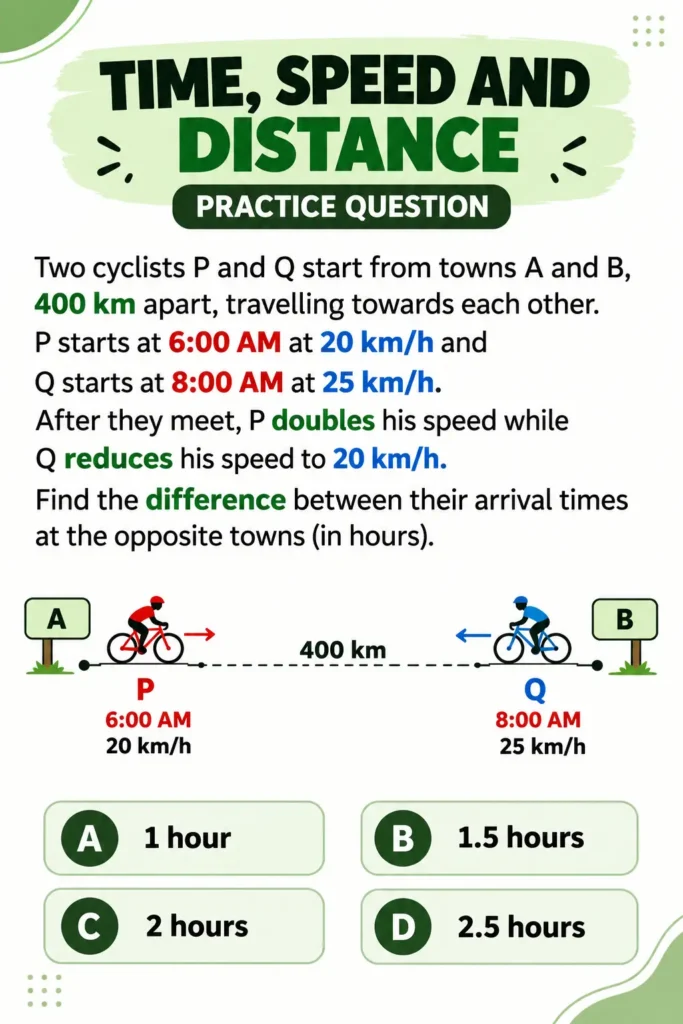
Think you have it? Drop your answer in the comments below, along with your method. We will reveal the correct answer and the shortest solution in the next post.
What’s Next
That wraps up Part 3 of the Time Speed and Distance series. If these questions felt heavy, that is a good sign: you are practising at the level where real exam marks are won. Revise the solutions, note which concept tripped you up, and keep practising time speed and distance tough questions like these before the next part.
Stay tuned for Part 4 on BrainQuro, and keep practising. See you in the next one.