
Introduction
Welcome to Part 4 of our series. If you have been hunting for Time Speed and Distance tough questions at the SBI PO and IBPS PO Mains level, this set is built for you. Every question needs four to five steps, and every answer is a clean integer.
This part covers ten different ideas: boat round trips solved with simultaneous equations, circular track meetings, trains crossing in both directions, average speed over equal distances, early and late arrival with a mixed walk and run, escalator step counting, races and head starts, meeting-point time ratios, a chase with a halt, and bus stoppages.
Attempt each question on your own before reading the solution. Even a wrong attempt will teach you more than reading the answer straight away.
Popular Math Topics
Table of Contents
Time Speed and Distance Tough Questions with Solutions
Attempt every question first, then check the solution below it.
Question 31
A motorboat takes 9 hours to travel 72 km downstream and 48 km upstream. It takes 11 hours to travel 48 km downstream and 72 km upstream. Find the total time the boat takes to travel 40 km upstream and then 72 km downstream.
Solution
Step 1: Let d be the hours taken per km downstream and u the hours taken per km upstream.
Step 2: From the data, 72d + 48u = 9 and 48d + 72u = 11.
Step 3: Adding both equations gives 120(d + u) = 20, so d + u = 1/6. Subtracting the second from the first gives 24(d – u) = -2, so d – u = -1/12.
Step 4: Solving gives d = 1/24 and u = 1/8. So downstream speed = 24 km/h and upstream speed = 8 km/h. (Boat speed = 16 km/h and stream speed = 8 km/h.)
Step 5: Time for 40 km upstream = 40 / 8 = 5 hours. Time for 72 km downstream = 72 / 24 = 3 hours. Total = 5 + 3 = 8 hours.
Check: 72/24 + 48/8 = 3 + 6 = 9 hours. 48/24 + 72/8 = 2 + 9 = 11 hours. Both match.
Answer
8 hours
Question 32
Two cyclists start together from the same point on a circular track. When they cycle in opposite directions, they meet for the first time after 36 seconds. When they cycle in the same direction, the faster cyclist overtakes the slower one for the first time after 180 seconds. The slower cyclist’s speed is 5 m/s. How many metres has the faster cyclist covered when the first overtaking happens in the same-direction case?
Solution
Step 1: Let the track length be L, and the speeds of the faster and slower cyclists be f and s.
Step 2: Opposite directions: f + s = L / 36. Same direction: f – s = L / 180.
Step 3: Adding the two gives 2f = L x (1/36 + 1/180) = L x 6/180 = L/30, so f = L/60. Subtracting gives 2s = L x (1/36 – 1/180) = L x 4/180 = L/45, so s = L/90.
Step 4: Since s = 5 m/s, L = 5 x 90 = 450 m. Then f = 450 / 60 = 7.5 m/s.
Step 5: Distance covered by the faster cyclist in 180 seconds = 7.5 x 180 = 1350 m.
Check: Opposite: (7.5 + 5) x 36 = 450 m, one full lap. Same direction: (7.5 – 5) x 180 = 450 m, one full lap. Also 1350 = 450 + 5 x 180 = 450 + 900, so the faster cyclist is exactly one lap ahead.
Answer
1350 metres
Question 33
Train P runs at 54 km/h and takes 30 seconds to cross a platform 330 m long. Train Q runs at 90 km/h on a parallel track. When the two trains run in opposite directions, a passenger sitting in P sees Q pass him in 5 seconds. Find the difference between the time the trains take to cross each other when running in the same direction and the time they take when running in opposite directions.
Solution
Step 1: Convert speeds. 54 km/h = 15 m/s and 90 km/h = 25 m/s.
Step 2: Length of P: it covers 15 x 30 = 450 m in 30 seconds, which is its own length plus the platform. So length of P = 450 – 330 = 120 m.
Step 3: Opposite directions, relative speed = 15 + 25 = 40 m/s. Q passes the passenger in 5 seconds, so length of Q = 40 x 5 = 200 m.
Step 4: Total length to cross = 120 + 200 = 320 m. Time in opposite directions = 320 / 40 = 8 seconds.
Step 5: Same direction, relative speed = 25 – 15 = 10 m/s. Time = 320 / 10 = 32 seconds.
Step 6: Difference = 32 – 8 = 24 seconds.
Check: Platform: 15 x 30 = 450 = 120 + 330. Q passing the passenger: 200 / 40 = 5 seconds. Both match.
Answer
24 seconds
Question 34
A car completes a journey in three parts of equal distance. It travels the first part at 20 km/h, the second part at 30 km/h and the last part at an unknown speed. The average speed for the whole journey is 30 km/h and the whole journey takes 12 hours. Find the difference between the time taken for the first part and the time taken for the last part.
Solution
Step 1: Total distance = average speed x total time = 30 x 12 = 360 km.
Step 2: Each part = 360 / 3 = 120 km.
Step 3: Time for the first part = 120 / 20 = 6 hours. Time for the second part = 120 / 30 = 4 hours.
Step 4: Time for the last part = 12 – 6 – 4 = 2 hours. So its speed = 120 / 2 = 60 km/h.
Step 5: Difference = 6 – 2 = 4 hours.
Check: 6 + 4 + 2 = 12 hours, and 360 / 12 = 30 km/h, which matches the given average.
Answer
4 hours
Question 35
A man walks to his office. If he walks at 4 km/h he reaches 15 minutes late, and if he walks at 5 km/h he reaches 9 minutes early. One day he walks at 4 km/h for part of the way and runs at 8 km/h for the rest, and reaches exactly on time. How many km did he walk?
Solution
Step 1: The difference between the two arrival times is 15 + 9 = 24 minutes = 0.4 hours.
Step 2: Let the distance be D. D/4 – D/5 = 0.4, so D/20 = 0.4 and D = 8 km.
Step 3: Time at 4 km/h = 8 / 4 = 2 hours. This is 15 minutes late, so the on-time duration = 2 – 0.25 = 1.75 hours.
Step 4: Let the walked distance be w km. Then w/4 + (8 – w)/8 = 1.75. Multiplying by 8 gives 2w + 8 – w = 14, so w = 6.
Check: Walking 6 km takes 1.5 hours and running 2 km at 8 km/h takes 0.25 hours. Total = 1.75 hours, which is exactly on time. At 5 km/h he takes 1.6 hours (1 hour 36 minutes), which is 9 minutes earlier than 1 hour 45 minutes. This also matches.
Answer
6 km
Question 36
An escalator moves upward at a constant speed. Kavya walks up the escalator at a steady pace and counts 45 steps to reach the top. When she walks down the same escalator at the same pace, she counts 90 steps. How many steps will she count if she walks up at three times her original pace?
Solution
Step 1: Let N be the number of visible steps, w her walking speed in steps per second, and e the escalator speed in steps per second.
Step 2: Walking up, her speed relative to the ground is (w + e), so the time taken is N / (w + e). Steps counted = w x N / (w + e) = 45.
Step 3: Walking down, her speed relative to the ground is (w – e), so steps counted = w x N / (w – e) = 90.
Step 4: Dividing the first by the second gives (w – e) / (w + e) = 1/2. So 2w – 2e = w + e, which gives w = 3e.
Step 5: Put w = 3e into the first equation: 3e x N / (4e) = 45, so N = 60 steps.
Step 6: New pace = 3w = 9e. Steps counted = 9e x 60 / (9e + e) = 54.
Check: Walking down at the original pace, she counts 3e x 60 / (2e) = 90, which matches.
Answer
54 steps
Question 37
In a 450 m race, A beats B by 50 m. In a 320 m race, B beats C by 40 m. A runs 450 m in 50 seconds. In a 630 m race, by how many seconds does A beat C?
Solution
Step 1: When A runs 450 m, B runs 400 m. So the speed ratio A : B = 450 : 400 = 9 : 8.
Step 2: A’s speed = 450 / 50 = 9 m/s, so B’s speed = 8 m/s.
Step 3: When B runs 320 m, C runs 280 m. So B : C = 8 : 7, which gives C’s speed = 7 m/s.
Step 4: Time for A over 630 m = 630 / 9 = 70 seconds. Time for C over 630 m = 630 / 7 = 90 seconds.
Step 5: A beats C by 90 – 70 = 20 seconds.
Check: In 50 seconds, B runs 8 x 50 = 400 m, which is 50 m behind A. B takes 40 seconds for 320 m, and in that time C runs 7 x 40 = 280 m, which is 40 m behind B. Both match.
Answer
20 seconds
Question 38
Two cars M and N start at the same time from towns A and B towards each other. After meeting, M takes 4 hours to reach B and N takes 9 hours to reach A. The speed of M is 60 km/h. Find the distance between A and B.
Solution
Step 1: Let the speeds of M and N be m and n, and let them meet after t hours. Before meeting, M covers m x t and N covers n x t.
Step 2: After meeting, M covers N’s pre-meeting distance in 4 hours, so n x t = 4m. Also N covers M’s pre-meeting distance in 9 hours, so m x t = 9n.
Step 3: Dividing the first by the second gives (n squared) / (m squared) = 4/9. So n / m = 2/3.
Step 4: With m = 60, n = 40 km/h.
Step 5: From n x t = 4m, 40t = 240, so t = 6 hours.
Step 6: Distance AB = 60 x (6 + 4) = 600 km.
Check: M covers 360 km before meeting and N covers 240 km, which adds up to 600 km. After meeting, M covers 240 km at 60 km/h in 4 hours, and N covers 360 km at 40 km/h in 9 hours. Both match.
Answer
600 km
Question 39
At 6:00 am, Car P leaves a city and drives along a highway at 40 km/h. It stops for a 30-minute breakfast halt from 9:00 am to 9:30 am, then continues at 40 km/h. At 8:00 am, Car Q leaves the same city on the same highway at 60 km/h. At what distance from the city does Q overtake P?
Solution
Step 1: By 8:00 am, P has covered 40 x 2 = 80 km, so the gap is 80 km when Q starts.
Step 2: Q gains 60 – 40 = 20 km every hour. Without any halt, Q would need 80 / 20 = 4 hours, which is 12:00 noon. This is well after P’s halt, so the halt must be included.
Step 3: Let Q travel t hours after 8:00 am. Distance of Q = 60t.
Step 4: P has been travelling for (t + 2) hours since 6:00 am, minus 0.5 hours of halt, so its moving time is t + 1.5 hours. Distance of P = 40 x (t + 1.5) = 40t + 60.
Step 5: Equate: 60t = 40t + 60, so t = 3 hours. The overtaking happens at 11:00 am.
Step 6: Distance = 60 x 3 = 180 km.
Check: P has been on the road from 6:00 to 11:00, which is 5 hours, minus the 0.5-hour halt, giving 4.5 hours of driving. 4.5 x 40 = 180 km, which matches Q’s 180 km.
Answer
180 km
Question 40
Bus P runs at 54 km/h excluding stoppages and at 45 km/h including stoppages. Bus Q runs at 60 km/h excluding stoppages and halts for 12 minutes in every hour. Both buses start together and take the same route. Bus P takes exactly 1 hour more than Bus Q to complete the route. Find the length of the route.
Solution
Step 1: Bus P loses (54 – 45) = 9 km every hour to stoppages, which is 9 / 54 = 1/6 hour = 10 minutes of halt per hour.
Step 2: Bus Q halts 12 minutes per hour, so it moves for 48 minutes each hour. Its speed including stoppages = 60 x 48 / 60 = 48 km/h.
Step 3: Let the route be D km. Time of P = D / 45 and time of Q = D / 48.
Step 4: D/45 – D/48 = 1. The common denominator is 720, so (16D – 15D) / 720 = 1, which gives D = 720 km.
Check: P takes 720 / 45 = 16 hours and Q takes 720 / 48 = 15 hours. The difference is exactly 1 hour.
Answer
720 km
Challenge Question for You
A cyclist plans to travel 200 km at a constant speed. After covering 40% of the distance, he increases his speed by 25% for the remaining distance and reaches his destination 36 minutes earlier than planned. What was his planned speed in km/h?
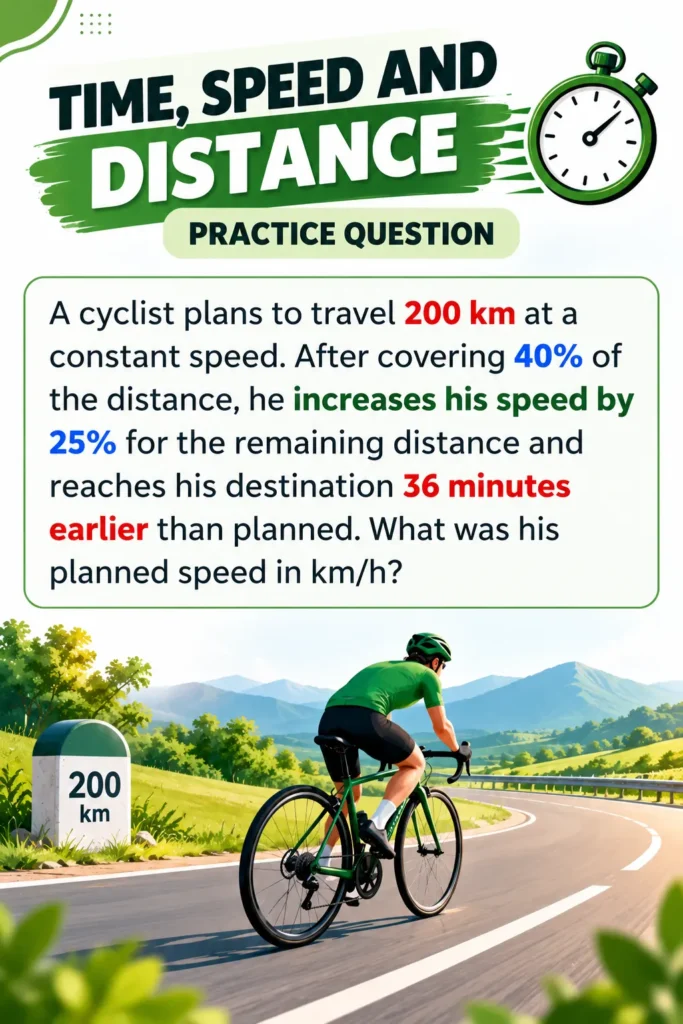
Comment your answer along with your method below. The answer will be revealed in the next post.
What’s Next
That wraps up this set of Time Speed and Distance tough questions. If you found a particular twist tricky, revise that solution and try a similar question without looking at the steps. Part 5 is coming soon on BrainQuro with another set of multi-step questions, so keep practising and keep commenting.