
Introduction
Welcome to Part 7 of our series. If you have been hunting for Ratio and Proportion tough questions that match the real SBI PO and IBPS PO Mains level, this set is built for you. Every question needs four to six steps, and every answer works out to a clean integer.
In this part we move beyond routine sums. You will work with milk and water replacement, linked age ratios, income and savings revisions, alloy mixing, partnership with withdrawals, coin exchanges, direct variation, continued proportion, weighted averages and a geometry twist on ratios.
Pick up a pen and a rough sheet, and attempt each question on your own before reading the solution. The real learning happens in the struggle, not in the answer key.
Popular Math Topics:
Table of Contents
Ratio and Proportion Tough Questions with Solutions
Attempt every question yourself first, then check the solution to compare your method.
Question 61
A vessel contains a mixture of milk and water in the ratio 7 : 3. From this vessel, 20 litres of the mixture is taken out and replaced with pure water. The ratio of milk to water in the vessel now becomes 7 : 5. Find the quantity of water, in litres, present in the vessel now.
Solution
Step 1: Let the total quantity of the mixture be V litres. Milk in the vessel = 7/10 of V.
Step 2: When 20 litres of mixture is removed, milk removed = 7/10 x 20 = 14 litres. Milk left = (7/10)V – 14.
Step 3: Pure water is added back, so the total is still V litres. The new ratio 7 : 5 means milk is 7/12 of V.
Step 4: (7/10)V – 14 = (7/12)V. So (7/10 – 7/12)V = 14, which gives (7/60)V = 14, so V = 120 litres.
Step 5: Water now = 5/12 of 120 = 50 litres.
Step 6: Check. Originally milk = 84, water = 36. Removing 20 litres takes out 14 milk and 6 water, leaving 70 milk and 30 water. Adding 20 litres of water makes water 50. Milk : water = 70 : 50 = 7 : 5. Correct.
Answer
50 litres
Question 62
The present ages of A and B are in the ratio 5 : 3, and the present ages of B and C are in the ratio 6 : 7. Four years ago, the sum of the ages of A and C was exactly three times the age of B at that time. Find the sum of the ages of A, B and C after 6 years.
Solution
Step 1: Make B common. A : B = 5 : 3 = 10 : 6, and B : C = 6 : 7. So A : B : C = 10 : 6 : 7.
Step 2: Let the present ages be 10k, 6k and 7k.
Step 3: Four years ago: (10k – 4) + (7k – 4) = 3 x (6k – 4).
Step 4: 17k – 8 = 18k – 12, so k = 4.
Step 5: Present ages are 40, 24 and 28, with a sum of 92 years. After 6 years, the sum = 92 + 3 x 6 = 110 years.
Step 6: Check. Four years ago the ages were 36, 20 and 24. A + C = 60 and 3 x B = 60. Also 40 : 24 = 5 : 3 and 24 : 28 = 6 : 7. Correct.
Answer
110 years
Question 63
The monthly incomes of Mohit and Naveen are in the ratio 8 : 5, and their monthly expenditures are in the ratio 3 : 2. Mohit’s monthly saving is exactly twice Naveen’s saving, and Naveen saves Rs 3,000 every month. Next year, Mohit’s income rises by 25 percent and Naveen’s income rises by 20 percent, while the expenditure of each rises by 10 percent. Find their total monthly saving next year.
Solution
Step 1: Let the incomes be 8p and 5p, and the expenditures be 3q and 2q.
Step 2: Mohit’s saving = 8p – 3q and Naveen’s saving = 5p – 2q. Given 8p – 3q = 2 x (5p – 2q), so 8p – 3q = 10p – 4q, which gives q = 2p.
Step 3: Naveen’s saving = 5p – 4p = p = Rs 3,000. So q = Rs 6,000.
Step 4: Present incomes: Mohit = Rs 24,000 and Naveen = Rs 15,000. Present expenditures: Mohit = Rs 18,000 and Naveen = Rs 12,000.
Step 5: Next year, incomes: Mohit = 24,000 x 1.25 = Rs 30,000 and Naveen = 15,000 x 1.20 = Rs 18,000. Expenditures: Mohit = 18,000 x 1.10 = Rs 19,800 and Naveen = 12,000 x 1.10 = Rs 13,200.
Step 6: Savings next year: Mohit = 30,000 – 19,800 = Rs 10,200 and Naveen = 18,000 – 13,200 = Rs 4,800. Total = Rs 15,000.
Step 7: Check. Present savings are Rs 6,000 and Rs 3,000, so Mohit saves twice as much as Naveen. Correct.
Answer
Rs 15,000
Question 64
Alloy P contains metals X and Y in the ratio 2 : 3, and alloy Q contains the same metals in the ratio 7 : 3. A jeweller melts 40 kg of alloy P with some quantity of alloy Q so that the new alloy contains X and Y in equal quantity. Find the quantity of metal Y, in kg, in the new alloy.
Solution
Step 1: Fraction of X in P = 2/5. Fraction of X in Q = 7/10. Required fraction of X = 1/2.
Step 2: By alligation, P : Q = (7/10 – 1/2) : (1/2 – 2/5) = 1/5 : 1/10 = 2 : 1.
Step 3: P = 40 kg, so Q = 20 kg. Total new alloy = 60 kg.
Step 4: Y in P = 3/5 x 40 = 24 kg. Y in Q = 3/10 x 20 = 6 kg. Y in the new alloy = 30 kg.
Step 5: Check. X = 2/5 x 40 + 7/10 x 20 = 16 + 14 = 30 kg. X = Y = 30 kg. Correct.
Answer
30 kg
Question 65
Aman starts a business with Rs 30,000. Bhanu joins him at the start with Rs 40,000 but withdraws Rs 10,000 at the end of 8 months. Chetan joins after 4 months with Rs 36,000. At the end of the year, the difference between the profit shares of Bhanu and Chetan is Rs 3,800. Find the total profit of the business.
Solution
Step 1: Aman’s investment x time = 30,000 x 12 = 3,60,000.
Step 2: Bhanu’s investment x time = 40,000 x 8 + 30,000 x 4 = 3,20,000 + 1,20,000 = 4,40,000.
Step 3: Chetan’s investment x time = 36,000 x 8 = 2,88,000.
Step 4: Ratio = 3,60,000 : 4,40,000 : 2,88,000. Dividing by 8,000 gives 45 : 55 : 36, with a total of 136 parts.
Step 5: Bhanu – Chetan = 55 – 36 = 19 parts = Rs 3,800, so 1 part = Rs 200.
Step 6: Total profit = 136 x 200 = Rs 27,200.
Step 7: Check. Shares are Rs 9,000, Rs 11,000 and Rs 7,200, which add up to Rs 27,200. Also 11,000 – 7,200 = 3,800. Correct.
Answer
Rs 27,200
Question 66
A bag contains Re 1, Rs 2 and Rs 5 coins in the ratio 6 : 5 : 4, and the total value of the coins is Rs 1,800. Some Rs 5 coins are taken out and exactly the same number of Rs 2 coins are put in their place, so that the ratio of Rs 2 coins to Rs 5 coins becomes 29 : 16. Find the total value of the coins in the bag after the exchange.
Solution
Step 1: Let the numbers of coins be 6k, 5k and 4k. Total value = 6k + 10k + 20k = 36k = 1,800, so k = 50.
Step 2: The coins are 300 of Re 1, 250 of Rs 2 and 200 of Rs 5.
Step 3: Let n coins of Rs 5 be replaced by n coins of Rs 2. Then (250 + n) : (200 – n) = 29 : 16.
Step 4: 16 x (250 + n) = 29 x (200 – n), so 4,000 + 16n = 5,800 – 29n, which gives 45n = 1,800 and n = 40.
Step 5: Each exchange lowers the value by Rs 5 – Rs 2 = Rs 3. So the value falls by 40 x 3 = Rs 120. New value = 1,800 – 120 = Rs 1,680.
Step 6: Check. The new coins are 300 of Re 1, 290 of Rs 2 and 160 of Rs 5. Value = 300 + 580 + 800 = Rs 1,680, and 290 : 160 = 29 : 16. Correct.
Answer
Rs 1,680
Question 67
The value of a gem is directly proportional to the square of its weight. A gem weighing 40 grams is worth Rs 3,20,000. It breaks into three pieces whose weights are in the ratio 1 : 3 : 4. Find the loss in value, in rupees, due to breaking.
Solution
Step 1: Value = k x (weight squared). So 3,20,000 = k x 1,600, which gives k = 200.
Step 2: The piece weights are 1/8, 3/8 and 4/8 of 40 grams, which are 5 g, 15 g and 20 g.
Step 3: Piece values: 200 x 25 = Rs 5,000; 200 x 225 = Rs 45,000; 200 x 400 = Rs 80,000.
Step 4: Total value of the pieces = Rs 1,30,000.
Step 5: Loss = 3,20,000 – 1,30,000 = Rs 1,90,000.
Step 6: Check. The sum of the squares of the weights is 25 + 225 + 400 = 650, and 650 x 200 = 1,30,000. Correct.
Answer
Rs 1,90,000
Question 68
Four positive numbers are in continued proportion, that is, first : second = second : third = third : fourth. The sum of the first and the fourth numbers is 175, and the sum of the second and the third numbers is 150. Find the difference between the largest and the smallest of these numbers.
Solution
Step 1: Let the numbers be a, ar, ar squared and ar cubed, where r is the common ratio.
Step 2: Given a x (1 + r cubed) = 175 and a x r x (1 + r) = 150.
Step 3: Dividing, (1 + r cubed) / (r x (1 + r)) = 7/6. Since 1 + r cubed = (1 + r) x (1 – r + r squared), this becomes (1 – r + r squared) / r = 7/6.
Step 4: 6 – 6r + 6 x r squared = 7r, so 6 x r squared – 13r + 6 = 0. This factors as (3r – 2) x (2r – 3) = 0, so r = 3/2 or r = 2/3.
Step 5: For r = 3/2: a x (35/8) = 175, so a = 40. The numbers are 40, 60, 90, 135. For r = 2/3 the same four numbers appear in reverse order, 135, 90, 60, 40.
Step 6: Largest – smallest = 135 – 40 = 95.
Step 7: Check. 40 + 135 = 175 and 60 + 90 = 150. Also 40 : 60 = 60 : 90 = 90 : 135 = 2 : 3. Correct.
Answer
95
Question 69
The average marks of three batches P, Q and R in a mock test are 80, 70 and 50 respectively. The numbers of students in P and Q are in the ratio 3 : 2, and the average marks of all the students of the three batches taken together is 70. If batch P has 15 more students than batch R, find the total marks scored by all the students together.
Solution
Step 1: Let P = 3a students, Q = 2a students and R = r students.
Step 2: Total marks = 80 x 3a + 70 x 2a + 50 x r = 380a + 50r.
Step 3: The overall average is 70, so 380a + 50r = 70 x (5a + r) = 350a + 70r. This gives 30a = 20r, so r = 1.5a.
Step 4: P – R = 3a – 1.5a = 1.5a = 15, so a = 10.
Step 5: P = 30, Q = 20 and R = 15, so there are 65 students in all. Total marks = 70 x 65 = 4,550.
Step 6: Check. 30 x 80 + 20 x 70 + 15 x 50 = 2,400 + 1,400 + 750 = 4,550, and 4,550 / 65 = 70. Correct.
Answer
4,550 marks
Question 70
The length and breadth of a rectangular field are in the ratio 9 : 5. If the length is increased by 10 metres and the breadth is decreased by 5 metres, the area of the field remains the same. Find the cost of fencing the original field on all four sides at Rs 45 per metre.
Solution
Step 1: Let the length be 9k metres and the breadth be 5k metres.
Step 2: The new dimensions are (9k + 10) and (5k – 5). Equal areas give (9k + 10) x (5k – 5) = 9k x 5k.
Step 3: Expanding, 45 x k squared – 45k + 50k – 50 = 45 x k squared, so 5k = 50 and k = 10.
Step 4: The original length = 90 m and breadth = 50 m. Perimeter = 2 x (90 + 50) = 280 m.
Step 5: Cost of fencing = 280 x 45 = Rs 12,600.
Step 6: Check. The new dimensions are 100 m and 45 m, and 100 x 45 = 4,500 = 90 x 50. Correct.
Answer
Rs 12,600
Challenge Question for You
Rs 9,600 is to be divided among three brothers, Arjun, Bhavya and Charu, aged 12, 15 and 20 years respectively, in the ratio inversely proportional to their ages. Arjun then gives 1/5 of his share to Bhavya, and after that Bhavya gives 25 percent of the amount she then has to Charu. Find the final amount with Charu.
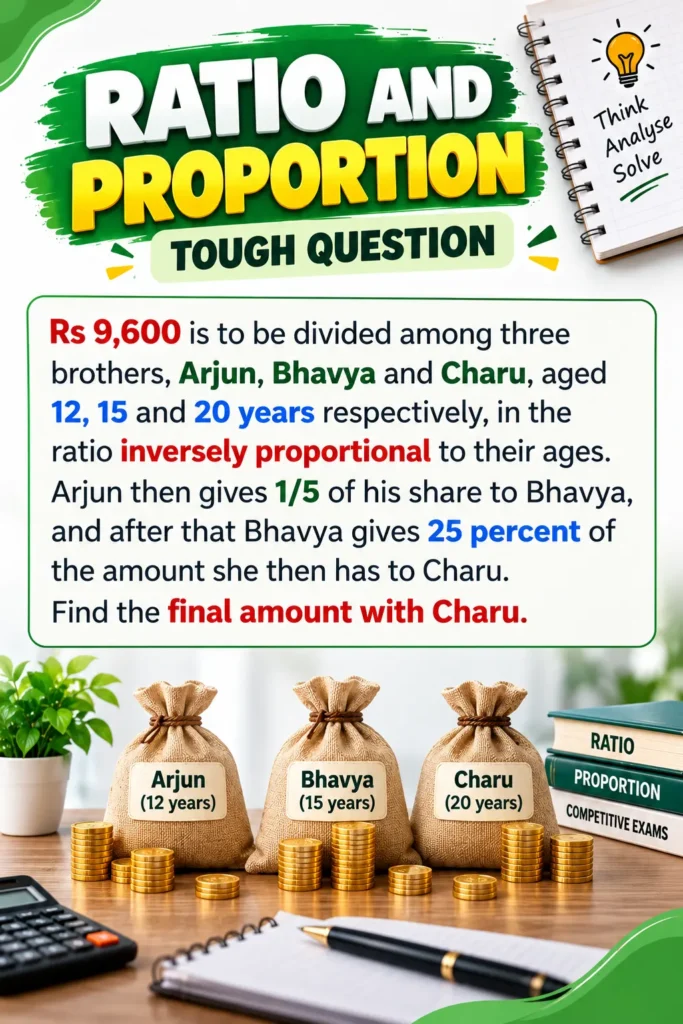
Think you have cracked it? Drop your answer and your method in the comments below. The answer will be revealed in the next post.
What’s Next
That wraps up ten more Ratio and Proportion tough questions, each built around a different twist. Revise any question that slowed you down, and try to rebuild the solution without looking. Part 8 of this series is coming soon on BrainQuro, so keep practising and see you there.