
Introduction
Ratio and Proportion looks simple until an exam puts it in disguise. One question hides it inside a milk mixture, the next inside a partnership, and another inside a boat running against a stream. Banking exams like SBI PO and IBPS PO Mains love this trick: the concept is basic, but the packaging is tricky.
Welcome to Part 6 of the BrainQuro Ratio and Proportion series. In this part, we move from basic practice to exam-level thinking. Each of the 10 questions below (Q51 to Q60) uses a different concept: successive replacement, ages, partnership, percentage change, work efficiency, alligation, boats and streams, geometry and mixtures. Every answer is a clean integer, just like in real exams.
How to use this post: read a question, try it on your own for at least 5 minutes, and only then read the solution. If you get stuck, the step-by-step method will show you where the shortcut was hiding.
Let us begin.
Here are 10 ratio and proportion tough questions that test every concept banking exams love.
Table of Contents
How to Solve Ratio and Proportion Tough Questions Faster
Question 51
A vessel is full of pure milk. First, 20% of the milk is removed and replaced with water. Then 25% of the mixture is removed and replaced with water. Finally, one-third of the mixture is removed and replaced with water. If the vessel now contains 90 litres of water, find the capacity of the vessel (in litres).
Solution
Step 1: Let the capacity of the vessel be T litres. Milk is always removed in proportion to its share, so we track only the milk.
Step 2: After the first operation, milk left = 80% of T = 0.8T.
Step 3: After the second operation, milk left = 0.8T x 0.75 = 0.6T.
Step 4: After the third operation, milk left = 0.6T x (2/3) = 0.4T.
Step 5: Water = T – 0.4T = 0.6T.
Step 6: 0.6T = 90, so T = 150.
Answer
150 litres
Question 52
The average age of A, B and C is 30 years. The ages of A and B are in the ratio 3 : 2, and the ages of B and C are in the ratio 4 : 5. After how many years will the ratio of A’s age to C’s age become 7 : 6?
Solution
Step 1: Total age of the three = 30 x 3 = 90 years.
Step 2: Make B common. A : B = 3 : 2 = 6 : 4 and B : C = 4 : 5. So A : B : C = 6 : 4 : 5.
Step 3: Sum of ratio = 15, so one part = 90 / 15 = 6.
Step 4: A = 36, B = 24, C = 30.
Step 5: Let it happen after t years. (36 + t) / (30 + t) = 7 / 6.
Step 6: 6(36 + t) = 7(30 + t), so 216 + 6t = 210 + 7t, so t = 6.
Answer
6 years
Question 53
A, B and C invest Rs 30,000, Rs 40,000 and Rs 40,000 respectively. C joins the business 3 months after it starts. A is the working partner and gets 15% of the total profit first. The remaining profit is divided in the ratio of capital multiplied by time. At the end of the year, A receives Rs 16,200 in total. Find C’s share of the profit.
Solution
Step 1: Capital x time: A = 30 x 12 = 360, B = 40 x 12 = 480, C = 40 x 9 = 360.
Step 2: Ratio = 360 : 480 : 360 = 3 : 4 : 3.
Step 3: Let the total profit be P. A first gets 0.15P. Remaining = 0.85P.
Step 4: A’s share of the remaining = 0.85P x 3/10 = 0.255P.
Step 5: A’s total = 0.15P + 0.255P = 0.405P = 16,200, so P = 40,000.
Step 6: C’s share = 0.85 x 40,000 x 3/10 = 10,200.
Answer
Rs 10,200
Question 54
Two numbers are in the ratio 5 : 8. When the first is increased by 40% and the second is decreased by 25%, the difference between the new numbers is 15. Find the sum of the original numbers.
Solution
Step 1: Let the numbers be 5k and 8k.
Step 2: First number after 40% increase = 5k x 1.4 = 7k.
Step 3: Second number after 25% decrease = 8k x 0.75 = 6k.
Step 4: Difference = 7k – 6k = k = 15.
Step 5: Original numbers are 75 and 120.
Step 6: Sum = 75 + 120 = 195.
Answer
195
Question 55
A, B and C together can complete a work in 12 days. A is twice as efficient as B, and B is 50% more efficient than C. A starts the work alone. After 5 days B joins him, and after 4 more days C also joins. In how many days in total is the work completed?
Solution
Step 1: B is 50% more efficient than C, so B : C = 3 : 2.
Step 2: A is twice B, so A : B = 2 : 1 = 6 : 3. Hence A : B : C = 6 : 3 : 2.
Step 3: Combined efficiency = 11 units per day. Total work = 11 x 12 = 132 units.
Step 4: A alone for 5 days = 6 x 5 = 30 units.
Step 5: A + B for 4 days = 9 x 4 = 36 units.
Step 6: Work done so far = 66 units. Remaining = 66 units.
Step 7: All three together do 11 units per day, so the remaining work takes 66 / 11 = 6 days.
Step 8: Total time = 5 + 4 + 6 = 15 days.
Answer
15 days
Question 56
A shopkeeper mixes two varieties of tea costing Rs 160 per kg and Rs 200 per kg, and sells the mixture at Rs 210 per kg, earning a profit of 25%. If the total mixture is 100 kg, how many kg of the costlier tea was used?
Solution
Step 1: Selling price = Rs 210 and profit = 25%, so cost price of the mixture = 210 / 1.25 = Rs 168 per kg.
Step 2: Use alligation. Cheaper (160) and costlier (200) with mean price 168.
Step 3: Cheaper : Costlier = (200 – 168) : (168 – 160) = 32 : 8 = 4 : 1.
Step 4: Costlier tea = 1/5 of 100 = 20 kg.
Answer
20 kg
Question 57
In a school, the ratio of boys to girls is 7 : 5. 20% of the boys and 40% of the girls wear glasses, and 136 students wear glasses in total. How many students do not wear glasses?
Solution
Step 1: Let boys = 7k and girls = 5k.
Step 2: Boys with glasses = 20% of 7k = 1.4k.
Step 3: Girls with glasses = 40% of 5k = 2k.
Step 4: Total with glasses = 1.4k + 2k = 3.4k = 136, so k = 40.
Step 5: Total students = 12k = 480.
Step 6: Students without glasses = 480 – 136 = 344.
Answer
344
Question 58
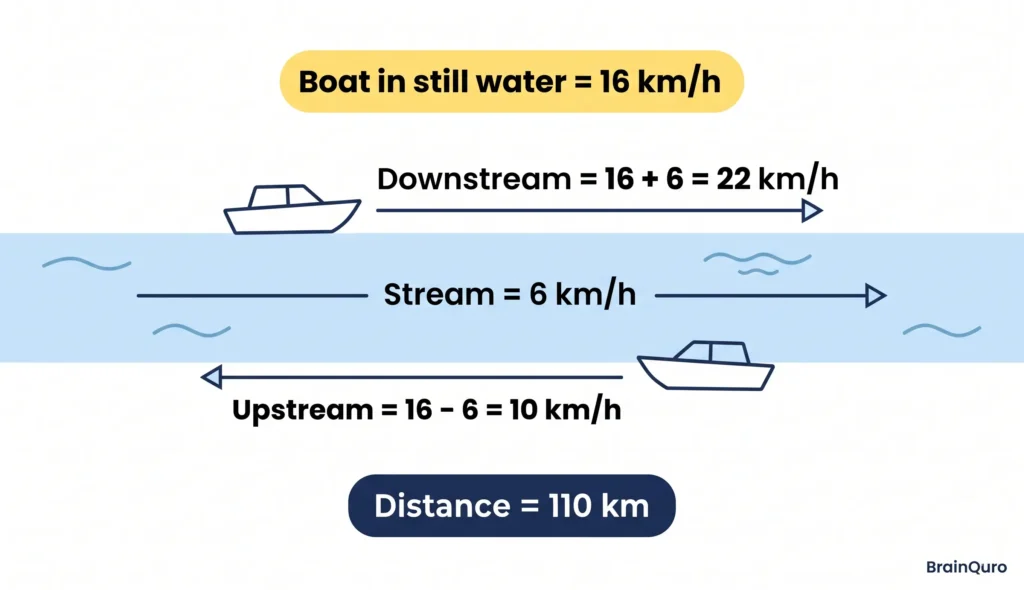
The ratio of the speed of a boat in still water to the speed of the stream is 8 : 3. The boat takes 6 hours more to go upstream than to go downstream over the same distance. If the speed of the stream is 6 km/h, find the distance (in km).
Solution
Step 1: Boat : Stream = 8 : 3. Stream = 6 km/h means 3 parts = 6, so 1 part = 2.
Step 2: Boat speed in still water = 8 x 2 = 16 km/h.
Step 3: Upstream speed = 16 – 6 = 10 km/h. Downstream speed = 16 + 6 = 22 km/h.
Step 4: Let the distance be d. Time difference: d/10 – d/22 = 6.
Step 5: d x (22 – 10) / 220 = 6, so d x 12 / 220 = 6.
Step 6: d = 6 x 220 / 12 = 110.
Answer
110 km
Question 59
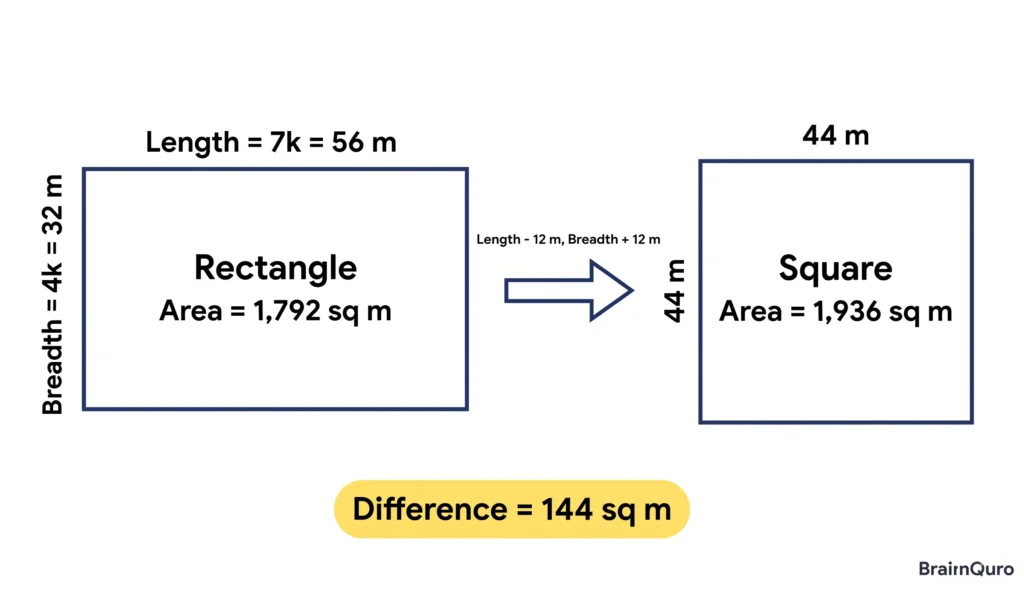
The length and breadth of a rectangle are in the ratio 7 : 4. If the length is decreased by 12 m and the breadth is increased by 12 m, the rectangle becomes a square. Find the difference between the area of the square and the area of the original rectangle (in square metres).
Solution
Step 1: Let length = 7k and breadth = 4k.
Step 2: For a square, the new sides are equal: 7k – 12 = 4k + 12.
Step 3: 3k = 24, so k = 8.
Step 4: Original rectangle = 56 m x 32 m, area = 1,792 sq m.
Step 5: Side of the square = 56 – 12 = 44 m, area = 44 x 44 = 1,936 sq m.
Step 6: Difference = 1,936 – 1,792 = 144.
Answer
144 square metres
Question 60
Three vessels with capacities in the ratio 3 : 4 : 5 are completely filled with mixtures of milk and water in the ratios 2 : 1, 3 : 1 and 3 : 2 respectively. All three are emptied into one large vessel, which then contains 80 litres of milk. Find the capacity of the largest vessel (in litres).
Solution
Step 1: Let the capacities be 3k, 4k and 5k litres.
Step 2: Milk in the first vessel = 3k x 2/3 = 2k.
Step 3: Milk in the second vessel = 4k x 3/4 = 3k.
Step 4: Milk in the third vessel = 5k x 3/5 = 3k.
Step 5: Total milk = 2k + 3k + 3k = 8k = 80, so k = 10.
Step 6: Largest vessel = 5k = 50 litres.
Answer
50 litres
Challenge Question for You
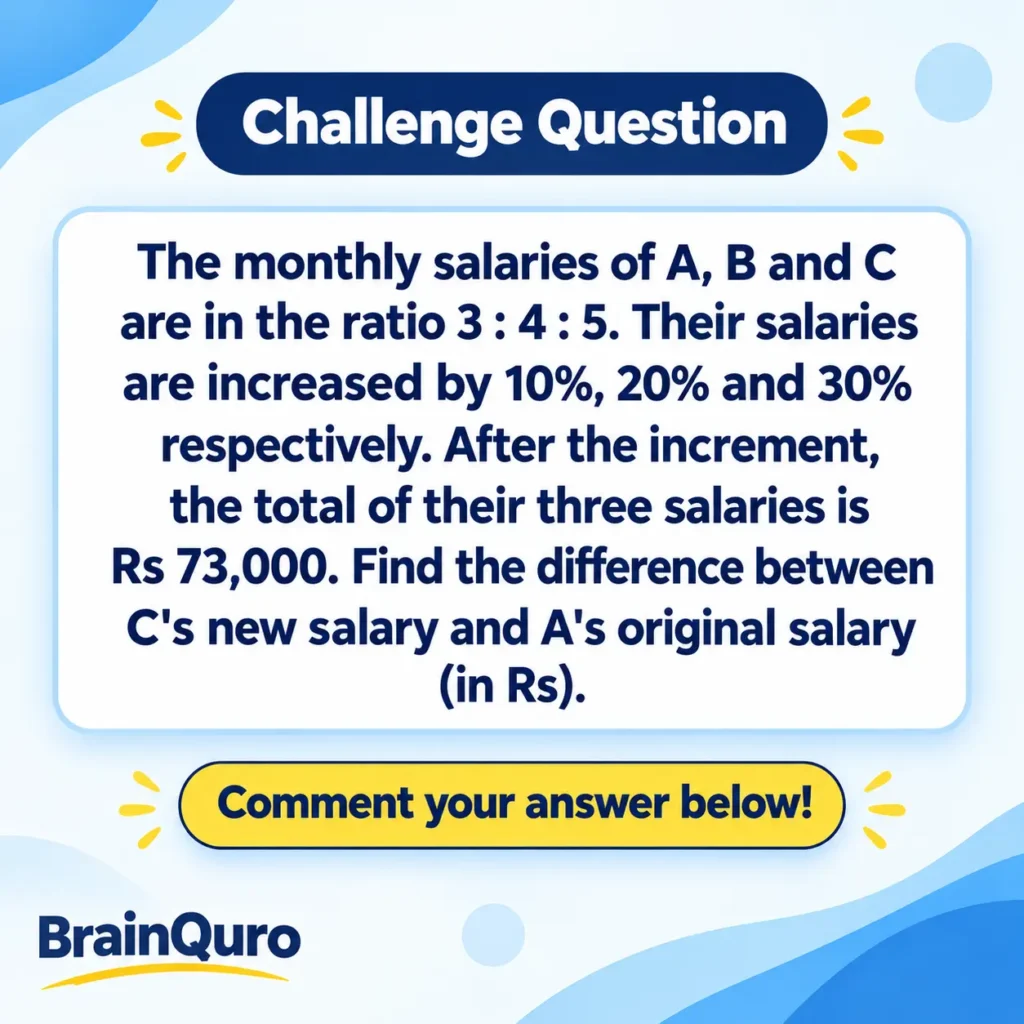
The monthly salaries of A, B and C are in the ratio 3 : 4 : 5. Their salaries are increased by 10%, 20% and 30% respectively. After the increment, the total of their three salaries is Rs 73,000. Find the difference between C’s new salary and A’s original salary (in Rs).
Think you have it? Drop your answer in the comments below, along with your method. We will reveal the correct answer and the shortest solution in the next post.
What’s Next
That wraps up Part 6 of the Ratio and Proportion series. If these questions made you sweat a little, that is exactly the point. Revise the solutions, note which concept tripped you up, and practise a few similar questions before the next part. Keep practising ratio and proportion tough questions like these before the next part.
Stay tuned for Part 7 on BrainQuro, and keep practising. See you in the next one.
Continue the Series
- Previous: Ratio and Proportion Part 5
- Next: Ratio and Proportion Part 7 (coming soon on BrainQuro)
Want more practice? Revisit the earlier parts of this series and attempt every question without looking at the solutions first.